The Bypass
Quay County, New Mexico

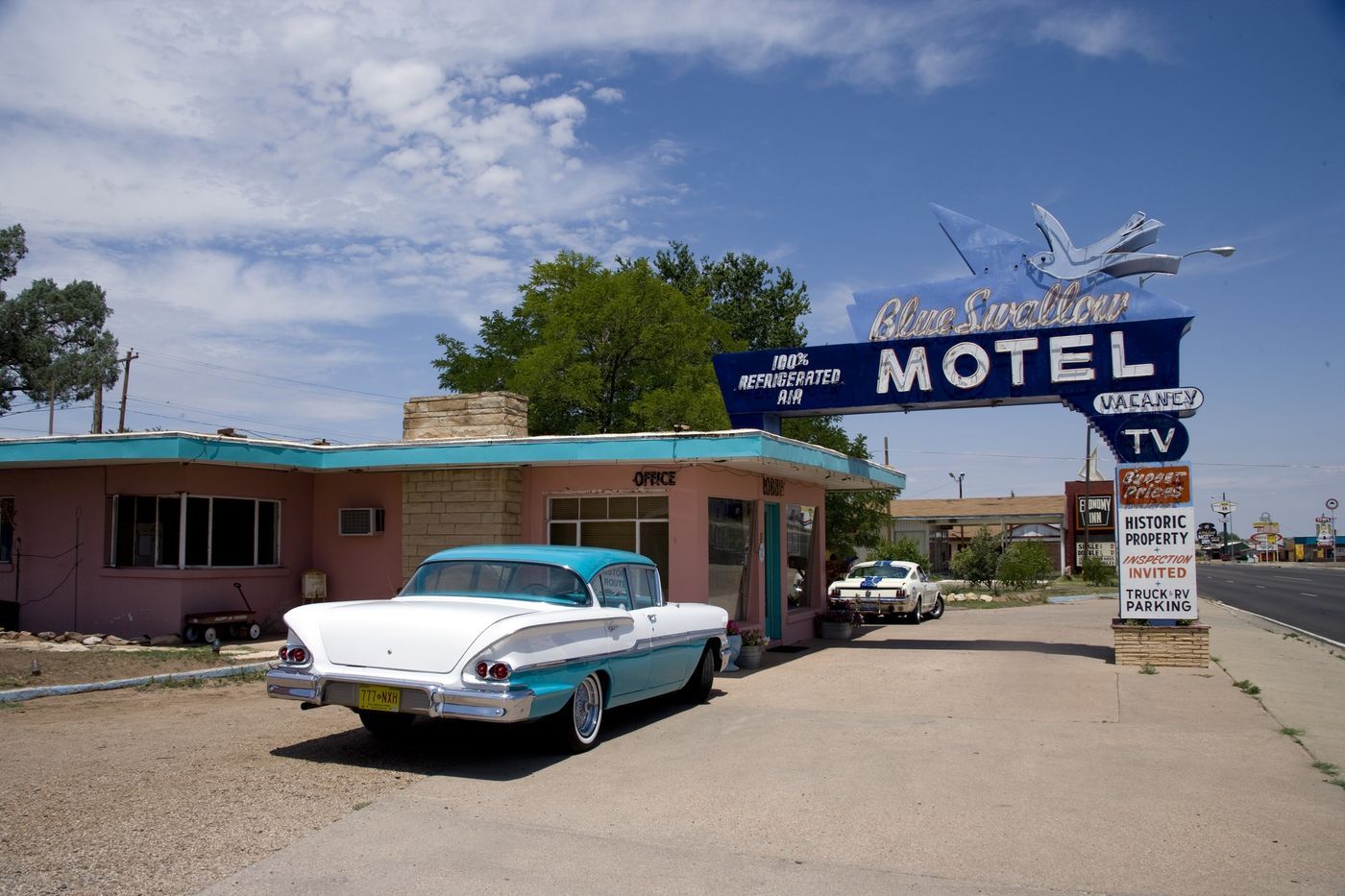
The name Tucumcari likely derives from a Comanche word meaning ‘to lie in wait.’ The town that took that name is still waiting.
A town named for waiting
The name Tucumcari likely derives from the Comanche word tukamukaru. To lie in wait for someone to approach.
The town has been doing exactly that for 125 years. Founded in 1901 as a railroad camp on the Chicago, Rock Island and Pacific line, Tucumcari became the county seat of Quay County — carved from Guadalupe County in 1903. By 1926, Route 66 ran through the center of town, and the rail stop became a highway stop. “TUCUMCARI TONITE!” the billboards read, for hundreds of miles in both directions. “2000 Motel Rooms.” The neon glowed. People stopped.
Then the interstate came through but went around, and the signs stayed lit for traffic that never exited.
The interstate went around
In 1981, I-40 bypassed the center of Tucumcari. The traffic didn’t vanish. Twenty thousand cars still pass daily. They just stopped getting off the highway. Motel rooms dropped from 2,000 to a few hundred. Quay County’s population has fallen to 8,510.
Pixar’s animation team drove Route 66 in 2001, guided by historian Michael Wallis. They modeled Radiator Springs partly on Tucumcari. The hand-painted “T” on Tucumcari Mountain became the “RS” above the fictional town. The Blue Swallow Motel’s individual garages inspired the Cozy Cone. And Sally Carrera’s line — “The town got bypassed just to save ten minutes of driving” — is the literal economic history of the place.
The movie was a love letter to what efficiency costs the places it passes through. The CDI data is the invoice.
The direct-need measures press high
Quay County’s dominant CDI domain is Safety Net & Buffer, scoring 88.05 out of 100. The domain ranks 102nd of 3,144 nationally. Disability and median household income sit at the 95th percentile of distress; poverty and child poverty sit above the 92nd. SNAP and transfer income remain useful context, but neither is one of the five measures scored in this domain. The poverty rate is 22.8%. Child poverty reaches 32.7%, meaning one in three children in the county is growing up below the poverty line. Median household income sits at $43,312 — 85% of the New Mexico median, and New Mexico’s median is already among the lowest in the country.
Watson’s BBQ closed on March 28, 2026. Jimmy and Stella Watson opened their store in 1980 as Tucumcari Ranch Supply — hardware and feed for the ranching economy. In 2008, when the economy went bad and drought hurt their ranching clients, they added barbecue. The feed store became the number one Yelp-rated restaurant on Route 66. After 46 years, the owners — now in their 70s — closed for good. The new owner is converting it back to a feed store.
A hardware store that became a restaurant because the economy changed, becoming a hardware store again because the owners aged out. The building outlasts every version of what it holds.
A budget built on a house of cards
In February 2026, Mayor Marcy Willis reviewed the city budget and said: “I am terrified. The budget last year was built on a house of cards.”
The numbers behind her terror. Revenue: $4.93 million. Expenditures: $11.39 million. A software error in the water billing system had charged some accounts a flat 3,000 units per month for over a decade, regardless of actual use. Other accounts showed bills as high as $900,000. The city halted water billing in October 2025. Months without water, sewer, or trash revenue.
By March 2026, the city imposed a spending freeze. All discretionary spending suspended. Three hundred of 2,300 accounts still unresolved.
Meanwhile, the Greater Tucumcari Economic Development Corporation has been “on hiatus” since mid-2024. Its former director departed amid unresolved financial records. The IRS revoked its nonprofit status in 2016. A state official warned the city it might miss a possible manufacturing facility because nobody is there to answer the call. A town named for waiting, and the office charged with making someone approach isn’t staffed.
Where the rent stopped working
I’ve written enough of these to know which domain to watch. For years Quay County’s housing numbers read soft. They don’t anymore. The Debt Burden domain has climbed to 63.24, driven by a rent-to-income ratio at the 88th percentile nationally. A two-bedroom apartment rents for $973 a month. Homeownership is 72.7%, so the half-income renter share stays low — but for the renters who are here, the rent now eats a share of income that puts the county in the top eighth of the country.
And the disability rate is 26.4% — the 95th percentile nationally. One in four residents lives with a disability. SNAP participation runs 27.9%. The Dr. Dan C. Trigg Memorial Hospital, opened in 1965, has 25 licensed beds and nine rooms in active use. The building likely contains asbestos and lead piping. Patients needing care beyond what those nine rooms can provide drive 80 miles to Amarillo or 175 to Albuquerque.
The rent in Quay County looks cheap by national standards. Against a $43,312 income, it no longer is. The cost of everything around it — healthcare, disability, the drive to a hospital that can treat you — never was.
What passes through, what stays
Wind turbines line the ridges east and south of Tucumcari. The New Mexico Wind Energy Center generates 200 megawatts across Quay and De Baca counties. Mesalands Community College runs a wind energy training center with a 1.5-megawatt turbine on campus. The wind comes through. The energy leaves on transmission lines. The tax revenue arrives in fractions.
And the county is fighting to keep its water. Quay County filed suit to stop a 130-mile pipeline from Ute Lake — the county’s reservoir — to Clovis and Cannon Air Force Base. In March 2026, county officials alleged fraud by the water authority.
Wind, water, twenty thousand cars a day. Things pass through Quay County. The question the town has been asking since the interstate bypassed it, since the railroad stopped running passengers, since the Comancheros rode out — is what stays.
The distress is not local
De Baca to the west scores 57.3. Moderate county distress. San Miguel to the northwest scores 64.7. Guadalupe to the southwest scores 60.5. Both carry moderate-high county distress. These three counties form a band of moderate-to-moderate-high distress across the eastern New Mexico high plains, far from Albuquerque, far from Santa Fe, far from the version of New Mexico that makes the tourism brochures.
Art City opened on a 40-acre former horse ranch outside town. Twelve large-scale sculptures, some purchased from Burning Man. A glamping resort and sculpture park billing itself as “Storm King meets Meow Wolf meets Marfa.” The pitch: make Tucumcari a destination, not a waypoint. Business applications peaked at 94 in 2023, then fell to 69 in 2024. I don’t know yet whether Art City and the wind program are genuine reinvention or another version of the same bet this town has always made: that someone passing through will stop. Mesalands Community College runs a dinosaur museum with the world’s largest collection of bronze prehistoric skeletons.
Quay County scores 63.26. Moderate-high county distress. The 856th most distressed county in the United States, out of 3,144. Fourteenth in New Mexico.
Lillian Redman ran the Blue Swallow Motel from 1958 to 1998. Forty years behind the front desk of a Route 66 motor court. “I end up traveling the highway in my heart,” she said, “with whoever stops here for the night.” The neon still glows. The rooms still book. The question is whether what’s inside the county — the poverty rate, the disability rate, the fiscal crisis, the nine-room hospital — can hold long enough for the next thing to arrive.