The Line
Petersburg city, Virginia

The third most distressed county in America sits inside the Richmond metro. Its nearest neighbor scores 47 points lower. The boundary is the mechanism.
The casino and what it’s driving into
Bruce Smith stood at the groundbreaking in March 2025 and said what everyone in Petersburg already knew. “For far too long people have simply driven by the City of Petersburg.” He was talking about the $1.4 billion casino resort he’s building with the Cordish Companies. A 450,000-square-foot complex with 1,600 slot machines, 200 hotel rooms, and a 4,000-seat entertainment venue. The temporary facility, a 75,000-square-foot tent on the site, pulled in $4.7 million in its first ten days.
Petersburg voted overwhelmingly in favor. In a city of 33,000 people, 10,265 voted yes. Fourteen hundred permanent jobs at an average $70,000 salary. Projected $240 million in tax revenue to the city over the next decade. A reason for people to drive to Petersburg instead of past it.
What they’re driving into is the third most distressed county in America.
The line on the map, the line on the budget
Virginia is the only state where cities are completely independent of their surrounding counties. No shared tax base. No shared services. No annexation. The line on the map is the line on the budget.
Petersburg sits inside the Richmond metropolitan area, 25 miles south of the state capital. Its neighbors are Chesterfield County, Prince George County, Dinwiddie County, and Colonial Heights — an independent city that incorporated itself out of Dinwiddie in 1948.
Brown & Williamson, the tobacco company that was Petersburg’s largest employer, was Petersburg’s largest employer for decades until it moved production to Macon, Georgia in the mid-1980s. Southpark Mall opened in Colonial Heights in 1989, and the retailers followed. Fort Gregg-Adams, the Army’s Sustainment Center of Excellence, generates $2.4 billion in annual economic output — from Prince George County, not Petersburg.
What’s left inside the line: a CDI score of 92.51. Extreme county distress, third in the nation out of 3,144 counties, first in Virginia. Chesterfield, directly across the boundary, scores 45.92 — moderate-low county distress. That 47-point gap remains among the widest neighbor disparities in the dataset.
The tax rates tell the rest. Petersburg charges $1.27 per $100 of assessed property value. Chesterfield charges 90 cents — and just cut its rate for the third consecutive year. The city with less charges more and still can’t maintain a water system whose main line is 75 years old and made of asbestos.
A renter city carrying a graduate’s debt
Petersburg’s distress runs across every domain at once — Default & Legal at 98.82, Debt Burden at 97.72, Delinquency at 97.35, each in the top 25 of all 3,144 counties — but the mechanism starts with housing. In Census Bureau estimates, owner-occupied homes are only 38.3% of the city’s occupied housing. This is a renter city, with rent-to-income at the 99.8th percentile nationally — fourth-highest of 3,144 counties, behind the Bronx, Santa Cruz County in California, and Brooklyn. 48.0% of renter households spend more than 30% of their income on housing. For 28.3%, it is more than half. In the Urban Institute’s credit panel, 45.4% of the population has debt in collections.
In the Urban Institute’s credit panel, student loan delinquency runs at 32.29%, higher than virtually every county in America. Virginia State University helps explain that number. The HBCU, founded in 1882, enrolls about 5,100 undergraduates. Ninety-two percent take out loans. The four-year graduation rate is 26%. The loan default rate is 15.2%, against a national average of 9.3%. Median earnings six years after graduation: $33,630.
Students borrow to attend an institution with a one-in-four chance of graduating in four years. Those who graduate earn $33,630. Those who don’t still carry the debt. The delinquency concentrates in the city where the school sits.
Then there’s the bankruptcy data. Petersburg filed 189 bankruptcies in the most recent year — 567 per 100,000 residents. Against Administrative Office of the U.S. Courts filing data, American Default puts that at the 27th-highest rate of the 3,033 counties with filings. The split: 95 Chapter 7, 94 Chapter 13. Almost exactly even. Chapter 7 is the liquidation chapter; Chapter 13 is the repayment-plan chapter. The split describes filing composition and does not establish filers’ assets, motives, or case outcomes.
One in five residents reports a disability. One in three children lives in poverty. Every child in the school system qualifies for free or reduced lunch. Not most. All of them.
What left Petersburg, and what stayed
Wyatt Tee Walker pastored Gillfield Baptist Church in Petersburg from 1953 to 1959. Gillfield, founded in 1797, is one of the oldest Black congregations in America. Walker integrated the public library and lunch counters, was arrested 17 times, and in 1960 became the first executive director of the Southern Christian Leadership Conference under Martin Luther King Jr. He planned the Birmingham campaign, the Children’s March, the March on Washington. The strategic architecture of the American civil rights movement was built in Petersburg.
Then it left.
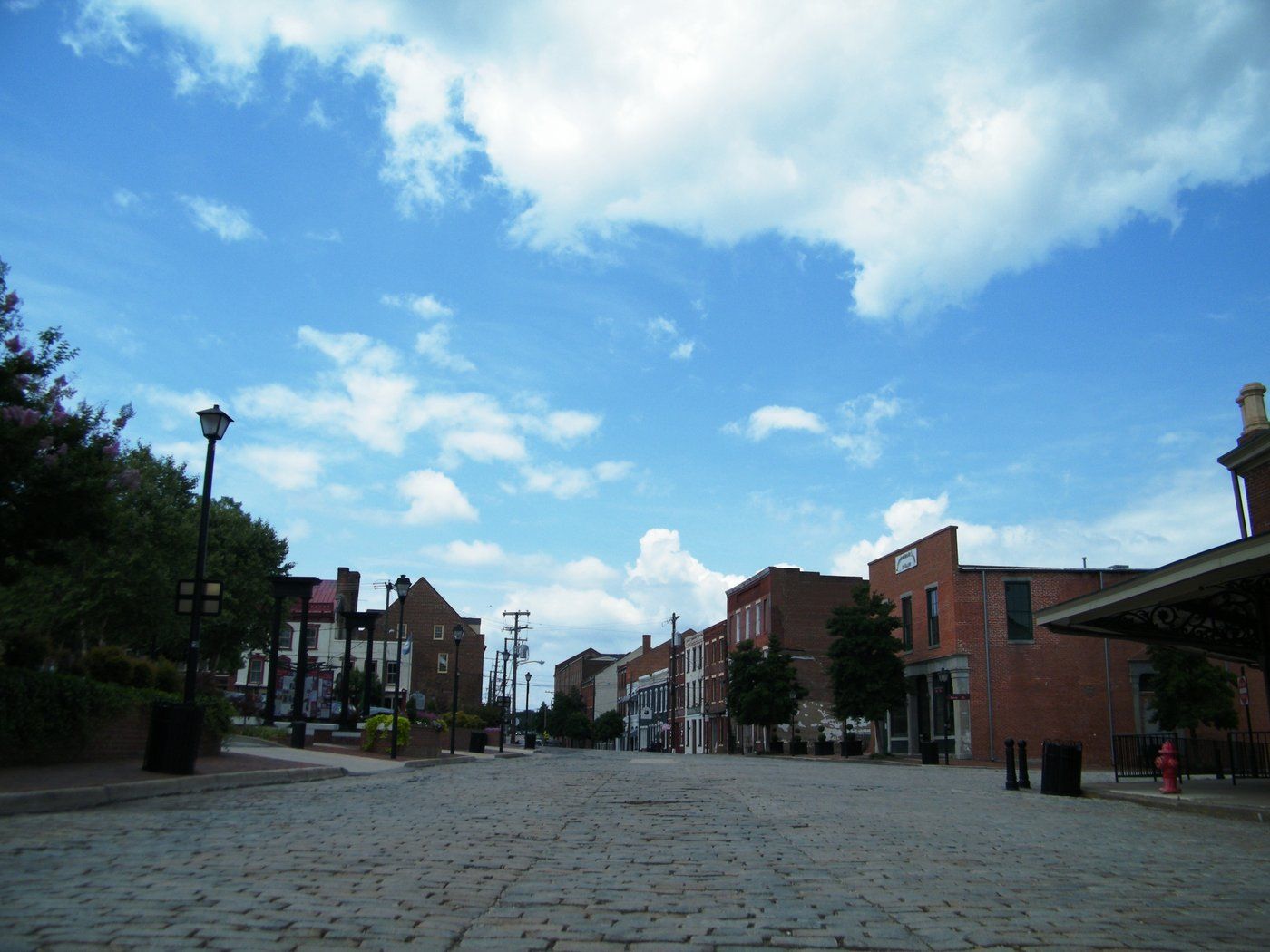
In 2018, the filmmakers behind Harriet used Old Towne Petersburg as their stand-in for 1850s Philadelphia. The cobblestone streets worked. The historic brick storefronts worked. The production crew dressed the buildings with horse-drawn carriages and period signage, then packed up and left. The streetscape was available because no one had invested in modernizing it.
I’ve written a dozen of these county profiles now, and Petersburg is the first where the pattern runs in one direction this consistently. The civil rights strategy left. Joseph Jenkins Roberts, born on Pocahontas Island — the oldest free Black community in America — left and became the first president of Liberia. Tim Reid built the only Black-owned film studio in America since the 1930s on 57 acres in Petersburg. Sold for $1.48 million in 2015. The tobacco jobs. The retail. The tax base. Things cross the line going out. The debt stays.
In 2016, Petersburg had $75,000 in available funds with $1 million in payroll due in two weeks and a $6 million budget deficit. The interim city manager told council the city had about a month before total collapse. By 2020, they’d clawed back to an $8 million positive fund balance. I don’t know whether the recovery or the collapse is the more revealing data point. Both are real. Both happened within the same city limits. The mayor says the city has close to $1 billion in infrastructure needs. In July 2024, a break in those century-old water mains triggered a citywide boil water advisory.
Whether the money crosses the line
The casino is the largest investment in Petersburg’s history. All four neighbors score lower on the distress index — the prosperity has always been right there, on the other side of the line. Whether $1.4 billion can finally move it across, whether the money stays inside the boundary instead of following the pattern that’s held since the tobacco factory closed and the mall opened and the base generated its billions from the next county over, is what the next CDI update will start to measure.