The Filing
Russell County, Alabama

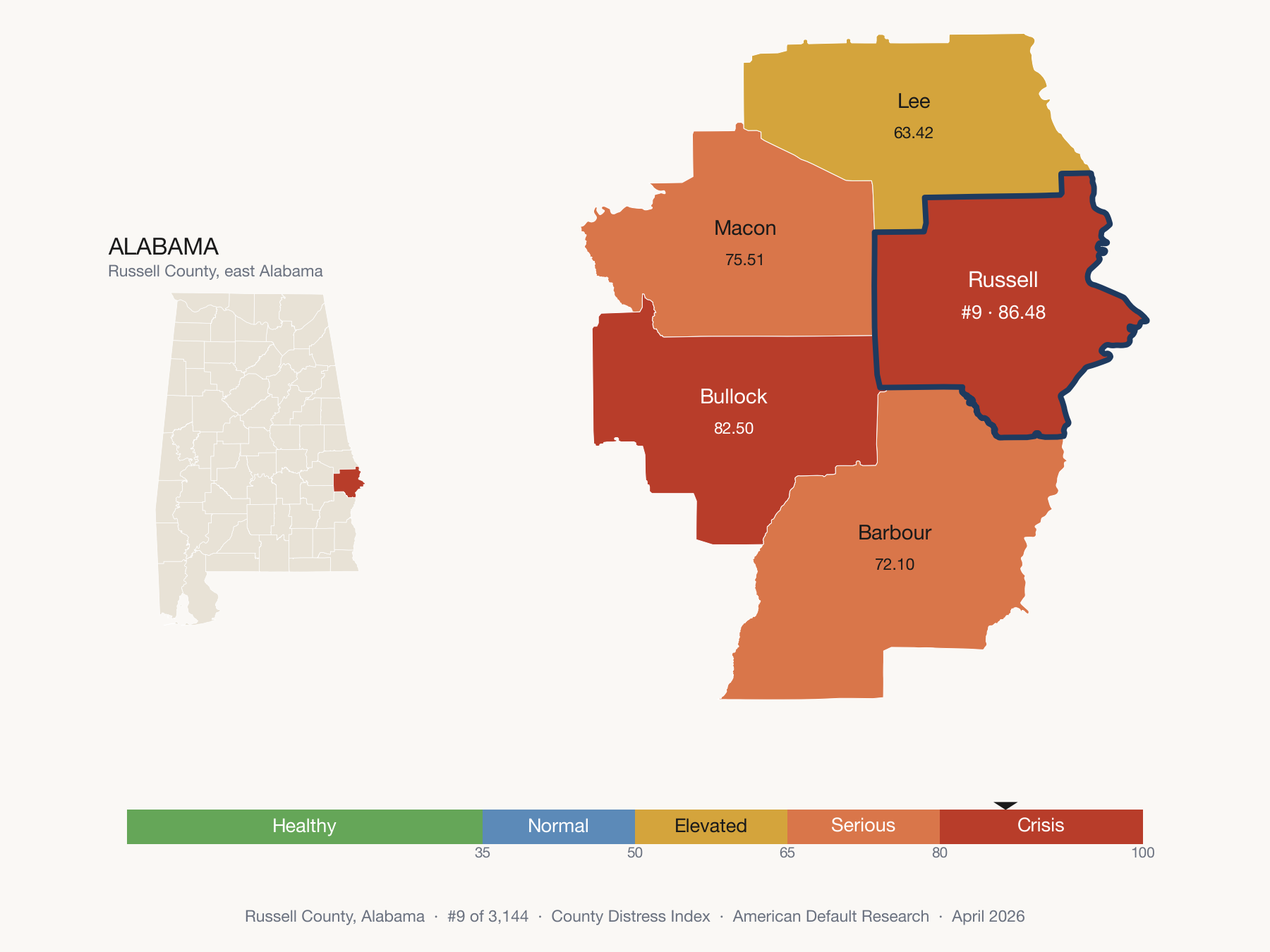
Ninth most distressed county in America. One of the highest bankruptcy filing rates in the country — roughly four times the national median. More than half of working Russell residents commute across the Chattahoochee River to Columbus, Georgia. The bridge carries the wages out. The court keeps the filings.
The bridge across the Chattahoochee
Phenix City sits on the west bank of the Chattahoochee River. Columbus, Georgia sits on the east bank. Three vehicle bridges cross between them: the Dillingham Street Bridge, the 14th Street Bridge, the J.R. Allen Parkway. On the Columbus side: the Aflac headquarters tower, the Riverwalk, the whitewater course carved out of the old textile-mill dam, Fort Benning’s gates a short drive south. On the Phenix City side: a smaller riverfront, fewer storefronts, and a county that ranks ninth most distressed in the United States.
More than fifty-four percent of Russell residents commute to a job in another state — most of them across that river to Columbus. By population share, that is the highest cross-state commuter rate of any county in the country. The labor market for Russell County is, literally, on the other side of the bridge.
Sin City and what came after
On June 18, 1954, Albert Patterson was shot and killed leaving his Phenix City law office. He had just won the Democratic primary for state attorney general on a platform of cleaning up the city’s organized vice. National press coverage had been calling Phenix City “the wickedest city in America.” The local economy was built on dice rooms, illegal liquor, prostitution, and clip joints serving soldiers from Fort Benning across the river.
Governor Gordon Persons declared a limited state of martial law. The Alabama National Guard occupied the county into January 1955, conducting raids and seizing slot machines. The Phenix City Story, the 1955 film about the events, won an Edgar Award. The city was named an All-America City the same year.
The vice was ended. What was supposed to replace it got built across the river — Aflac, Fort Benning, the I-185 warehouse corridor, the Columbus Riverwalk redevelopment of the 2000s. Phenix City got the soldiers’ off-duty money for decades, then got the cleanup, then got the county seat of a place where bankruptcy filings run roughly four times the national median.
The filing rate
The number that defines Russell County in 2026 is 484. That’s the bankruptcy filing rate per 100,000 residents — among the highest in the country. The national median is 130. Russell files at nearly four times that rate.
Bankruptcy is a federal court process. The U.S. Bankruptcy Court for the Middle District of Alabama, Eastern Division, sits in Opelika, about thirty miles northwest. Russell residents file there at one of the highest rates in the country.
Forty-five percent of residents with a credit file carry debt in collections, against a national median of twenty-three percent. Forty-three percent are subprime — credit scores below 660. Credit card delinquency is ten percent, double the national rate. Auto loan delinquency is ten percent, also double. Medical debt in collections is twelve percent, three times the median.
These numbers are surveyed at the same moment unemployment in Russell County sits at four percent, near the national median. People are working. The wages don’t close the gap.
The renter county in a state of owners
Alabama is a state of homeowners. About three quarters of Alabama households own the place they live. In Russell County, the homeownership rate is sixty-one percent — the eighth percentile nationally. Phenix City absorbed the soldier-rental economy of the mid-twentieth century and never converted it to homeowner stock at the same rate as the rest of the state.
Forty-eight percent of renters spend at least thirty percent of their income on rent. Twenty-four percent spend more than half. House prices fell four percent over the past year, while the national median rose four percent. The county is renting at the prices of an appreciating market, in a market that has stopped appreciating.
The Chattahoochee gradient
I’ve written enough of these county profiles to recognize the geography. Russell scores 86.68, Crisis. Chattahoochee County, Georgia — the next county downriver, where most of Fort Benning sits — scores 58.1, Elevated. That twenty-eight-point drop across the river is among the widest neighbor disparities in the dataset.
Chattahoochee County contains the federal payroll. The off-base spending was always supposed to cross the bridge. What crossed instead was the consumer credit demand. The Aflac jobs are real, the Columbus paychecks are real, the I-185 warehouse jobs are real — and a Russell resident driving home from any of them pays Russell rent, files Russell bankruptcies, and lands in the Eastern Division’s federal-court intake.
What the filing rate measures
The Phenix City Riverwalk has been extended in segments over the past decade. There’s a kayak rental, a small amphitheater, restaurants. The view across to Columbus is stunning. The view back from the Georgia side is increasingly worth taking.
CDI score: 86.68. Crisis zone. Ninth most distressed county in the United States. First in Alabama. Tied at the top of the Legal Distress domain with forty-five other counties.
Bankruptcy is the formal admission that a household has run out of working room. The filing rate measures how often that admission becomes necessary. Russell residents make that admission more often than the residents of all but a handful of other U.S. counties. The bridge carries the wages out. The court keeps the filings.